


|
||||
|
||||
|
Letter from the Editor: Girl Time
Oh, yes, and since sample spatulas are
so very popular, we purchased a really cute style known as the
"boomerang."
How to make lotion in a Blender with Deborah Dolen has been updated for 2010 and relocated
Holistic Pet Care Ideas (Please click here to see our new pet division with GREAT recipes) As you may have read
in the last newsletter, Gabrielle, a five year old Golden Retriever we recently
adopted, is our new Editor in
In response to our last article
about pets and health care, one reader had this to say:
There are pills or can come in liquid form to take that can contain Omega-3, Omega-6, Biotin for example. A television show suggested sesame oil from the grocery store. My vet suggested peanut oil that can even be bought in a gallon sized container at the grocery store when I bulked at the expensive pills I could have gotten instead. I opted for the peanut oil since it was the cheapest since we have to buy Thyroid and Estrogen pills for our dog. I don't measure but it is a teaspoon or slightly less I mix right in with the dog food each time. I feed my dog three times a day. My dog had constant rashes. After giving her the peanut oil, her skin problems have been cut 95%! Her fur is so soft now. I was told if my dog got stomach upset to start with a small amount but my dog, Sara, had no problem. Gabrielle looks soooo cute! Sylvia If anyone has tips on how to use essential oils on a dog's fur and what oil to put on their food for a better coat, and so on, please submit to mabelco@tampabay.rr.com Attention: Gabrielle. I have read a lot of stuff on the net regarding pet care, but have long forgotten most of it.
I get many e-mails asking how to make labels, find the right labels for homemade products and so on. In a previous issue, I discussed the very basics of FDA labeling rules which are paramount to be aware of. Click here to see that article. As for the low-down on making labels, lets get to it! First of all, most containers are white, so it is easy enough to obtain white labels. (I swear that clear labels smear and you will totally regret using them.) I bought Avery Label Design Pro a few years ago. To make labels, I simply type in the label style number into their software, and from there I can design my labels, as the right measurements do pull up properly. My canvas to work with is clear. The program was around $25 last I knew. Since office supply stores seem to carry three brands, Avery, Avery, and Avery, I figured sticking with Avery was a wise move. Labels are not a huge area of expense, but the final product of your labels is EVERYTHING! You can print up to 90 labels per page if you get the smallest size! That is kind of a return address label. When I have a product I want to package, I find the container first, preferably white. I make sure who ever I am buying my containers from is a strong company with a fair price and will be there if I find I need more containers. You do not want to be stuck with a theme that does work, sells great, and suddenly have no source for your containers. For that reason, I make sure that the company I am buying containers from is not the only one selling the item, and have a plan "B" on where I would get them. With a plan "B" in hand, I proceed to do the following: I put all of the containers I am considering into a tasteful bag with a handle and walk into a local office supply store with the bag. Having the containers or packaging with me helps me match up what Avery label number would be appropriate, if any. I then write the Avery style number that fits best on the container in permanent marker. I usually do not buy anything that day--I just go home and think about what looked best. Sometimes I just have to go to the Avery site because the store may not sell unique cuts I know they offer, such as round ones, for our lip balm tins. As for the graphics that I choose for the label, well, I usually create them or pull them into Paint Brush to work on. Paint Brush is a very simple Windows feature. I have used many sophisticated graphics systems in the past ten years and I have found that good old Paint Brush really does so much for such a simple program. Anything Paint Brush cannot do, I may clean up in a more serious graphics program. I do not want color around my label, as very few labels print to edge. You just want to use all the color you can in the middle. I typically pull my graphic through Avery Design Pro and use the Avery fonts to write my text. This is because pulling text in though Avery or any program from another program, looks very fuzzy and just not clean. At times I write my test right over the graphic I pulled in. To make labels stick better, I run a GLUE STICK across each one as I place it on the container. I want to be sure the label is going to stay put. I have been told to spray the entire sheet of labels with a coat of acrylic spray, before I start using the sheet, so they will not bleed or run as bad if they get near water. Another good solution is to find shrink bands for your containers and this helps with the "tampering" rule as well as protects your label. Shrink bands slide over the product and a blow dryer will make it conform! The last resort to avoiding stickers altogether would be the "hang tag" method and that is simply a business card folded in half. I have seen MANY cute tags done this way, usually around the neck of a product. Once it is folded in half, you simply place a neat hole punch at the top corner and you can secure the hang tag onto your product using the hole, with raffia, string, or whatever seems to fit your theme. This can also be created in Avery using their business card stock. I hope this article was helpful!
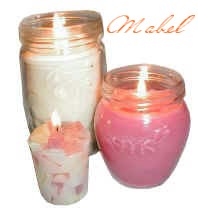
How to Make Soy Candles: Making Yankee Type Candles for Under $4
The inventor of
SoyWax™ told me
that keeping the wick
straight, is a three step process. Pour an inch of soy Wicks: German Cotton Braided wicks are considered the best. I buy mine long so I can always cut to size. Better to long that too short! Zinc wicks are not meant for natural products. Paraffin is a man made product. So, the key to remembering wick size is natural/soy/cotton and man made/paraffin/metal wick. Another issue is that many vendors are selling donut oil as SoyWax™, and this is causing the candle to drown rather early. Fragrance: Soy has as a good a fragrance throw as Paraffin based candles. I use about 1 ounce of fragrance oil per pound of soy when making candles. Our fragrance was made especially for a good "throw" for soy candles. Too much of any fragrance oil, and your candle will drown. I also add 2-5% beeswax to my soy candles for a very rich opaque consistently. Beeswax is so hard, I start melting that before I start melting soy in with it. Vybar helps a candle keep its color and is a great aid to help fragrance oils bind to the wax. Vybar looks like white wax chips. Vybar is not critical to a good candle--just nice to have. A teaspoon per pound. Color: Pigments and dyes seem to be a major culprit in a "sick" candle. Everything goes through the wick, including fragrance--so be sure any color you use is oil based and made for soy wax. Soy should not be poured while piping hot because it will cause a curdled effect. I would also add my fragrance oils in once the wax has cooled down a bit so they do not evaporate with such high heat. Until recently, soy could only produce pastel colors, no matter how much color you wanted to add. Making a
|

 Yes,
its "girly" time. We have just added the cutest accessories
in the world to our supply
Yes,
its "girly" time. We have just added the cutest accessories
in the world to our supply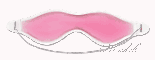


 Chief of our Family Pet's
division. Judea Bentley, one of our editors from Nebraska
suggests to put a teaspoon of coconut oil in a canine's food for over all good
health and a nice coat.
Chief of our Family Pet's
division. Judea Bentley, one of our editors from Nebraska
suggests to put a teaspoon of coconut oil in a canine's food for over all good
health and a nice coat.  into the
jar, first inserting the wick in the center as it cools. Once the wick
is stable, then pour the majority of the candle, adjusting the wick again as that cools. This tends to cause a line across the top of your
candle when you pull it straight. Thus for the last step after you center the
wick, he pours a final 1/2" or so layer to cover up the line
at the top of the candle that centering the wick caused.
I cheat and just glue gun my wicks straight in the glass before I
even get started on pouring.
into the
jar, first inserting the wick in the center as it cools. Once the wick
is stable, then pour the majority of the candle, adjusting the wick again as that cools. This tends to cause a line across the top of your
candle when you pull it straight. Thus for the last step after you center the
wick, he pours a final 1/2" or so layer to cover up the line
at the top of the candle that centering the wick caused.
I cheat and just glue gun my wicks straight in the glass before I
even get started on pouring.