
| | Home | | About Us | | Videos | | Supply Co | | Archives | | Catalog | | Contact Us | | Bookmark Us | Bookstore | |
Holiday Season 2007
|
|
|

| Most Popular Scents |
|
Yippee the holidays are almost here! The first major change at Mabel is we have a new search feature. I have written so much over the years, even I forget a good recipe or formula. More so when it is a holiday one. So, if you go to Archives, it now has a nifty search tool. It will search the Archives, and/or the supply company. The search tool in the actual supply company also works. I love the new search tool. I tested Wassail and found that recipe right quick. Rum or Cognac aficionados may want to get on top of the no bake fruit cake recipe now. I love that recipe and it seems to be better when aged. Do a search on that, the recipe comes up in second place. What Sells? I am asked that quite often by people wanting to sell their own hand made products. Across the country various friends of mine opened up bath and body type shops this year. Here is what I learned does sell in any location: Anything lavender, almost anything lemon, and the same with vanilla and coffee/espresso. Spread yourself out and do not invest all on floral--just because you like floral. You really need a floral, fruit, sweet and spicy scent at minimum. When it comes to bases, anything dead sea--such as body scrubs, and bath salts. Body Butters came in second to body scrubs and bath salts. So, I would sell dead sea bath salts and body scrubs in lavender, lemon, and coffee/caramel. If I am ambitious, I would make matching candles with room sprays. I feel the room spray expresses a good scent best--and you can spritz away before guests arrive. I would attach a room spray to a candle with a ribbon and just sell it as a package. So, if I sold gift baskets, you can assume I would have a dead sea body scrub, bath salts, with a matching body butter, and a candle with a matching room spray. A few bath bombs or fizzy bath salts would not hurt either. More fun, I may add scented sachets for the closest and drawers. Sachets are great gifts and often an item people will not buy for themselves.
Making Lotion or Crème Made Easy: Free Pouring This motion making article has been updated and improved - please click link for its new location.
Holiday 2007 most popular fragrances: Crème Brulee, Mulberry, Mulled Cider, Harvest, Espresso, Sandalwood, Gardenia (serious big seller this year,) Lilac, Cotton, Linen. Holiday 2007 most popular flavors: Apple Cinnamon, Red Hot Cinnamon, Cotton Candy, Peppermint, Almond, Lemon Drops, Espresso Latte', Butter Rum, Chocolate Mint, Cool Berry. Clearance Chocolate Molds: 10 Molds in a Box
In the video I recommend just buying Nestle chips, they are the best quality on the store shelves. I also dissuade people from buying the "other" dipping type chocolate as it contains too much wax. Click here to buy the molds. *While supplies last. Have a GREAT holiday season!
Gloxi is so neat I wanted to carry it on the site. Unfortunately it comes in refrigerated and is not stable until it is in an environment such as lotion or cream. The handling is so special, I do not envision this becoming available on the open market. If anyone did carry it, I would question if they cared about its effectiveness. You really need to be a professional to handle it. Why? Basically the milk and sugar enzymes do a great job as a broad spectrum preservative, unless it is exposed to air over and over. Opening up a jar and sticking a finger in, creates more havoc than we know. Well, we know a little bit. We know the stores in the malls use sample spatulas. This is the reason. Beyond introducing little buggers that a human eye cannot see--Gloxi does not like Oxygen. Air is like Kryptonite to Gloxi. Enough air and the milk and sugar enzymes will turn into hydrogen peroxide and no longer work to fight micro bugs. When handled properly, I LOVE GLOXI! We do offer a Gloxi lotion base in our Wholesale section. It is known as Soytanicals Lotion PLUS. I am getting besieged with calls for this as well as the Soy Spa Bath, wax dipping product. Since they are both based on Soy Lipids, and compliment each other, I am putting them under one brand. Soytanicals. I do need more performance testing, in a professional environment. If you have anything to do with a spa, I can send substantial samples as long as shipping is covered. Click here to contact me. Natural Preservative Grapefruit Seed Extract Seed Extract - Not So Natural
|



 :
Updated January 28th, 2010
:
Updated January 28th, 2010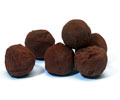 Carrying
chocolate molds was difficult because they take an unusually wide
box. Because they do not fit in our normal boxes--I am selling
them in trays of 10, as a clearance item. I am selling ten
molds in a wide flat rate box for $30 and they are already boxed up.
Retail value is at least $80. There are ten molds in each flat
rate box--a variety with none repeated. At least in each box 5
are traditional molds such as cordial, cups, and turtles. At
least 4 are holiday, Thanksgiving, Christmas and some Easter.
Each mold has many cavities. And I will throw in my on-line
Chocolate making video. In fact, anyone can
Carrying
chocolate molds was difficult because they take an unusually wide
box. Because they do not fit in our normal boxes--I am selling
them in trays of 10, as a clearance item. I am selling ten
molds in a wide flat rate box for $30 and they are already boxed up.
Retail value is at least $80. There are ten molds in each flat
rate box--a variety with none repeated. At least in each box 5
are traditional molds such as cordial, cups, and turtles. At
least 4 are holiday, Thanksgiving, Christmas and some Easter.
Each mold has many cavities. And I will throw in my on-line
Chocolate making video. In fact, anyone can
 Glucose oxidase and lactoperoxidase
are basically natural sugar and milk enzymes used as
preservatives in place of the typical parabens. You may be
familiar with these terms because Burt's Bees recently started using
them in their lotions. These two compounds are so hard to pronounce, I call
them "Gloxi." As far as natural preservatives go, I
would not consider compounds such as "grape seed extract," in and of
itself, a broad spectrum preservative by any means. Any
emulsion such as lotion, really needs more protection from
micro-bugs than greed seed extract.
Glucose oxidase and lactoperoxidase
are basically natural sugar and milk enzymes used as
preservatives in place of the typical parabens. You may be
familiar with these terms because Burt's Bees recently started using
them in their lotions. These two compounds are so hard to pronounce, I call
them "Gloxi." As far as natural preservatives go, I
would not consider compounds such as "grape seed extract," in and of
itself, a broad spectrum preservative by any means. Any
emulsion such as lotion, really needs more protection from
micro-bugs than greed seed extract.